

Views: 0 Author: Site Editor Publish Time: 2025-09-23 Origin: Site


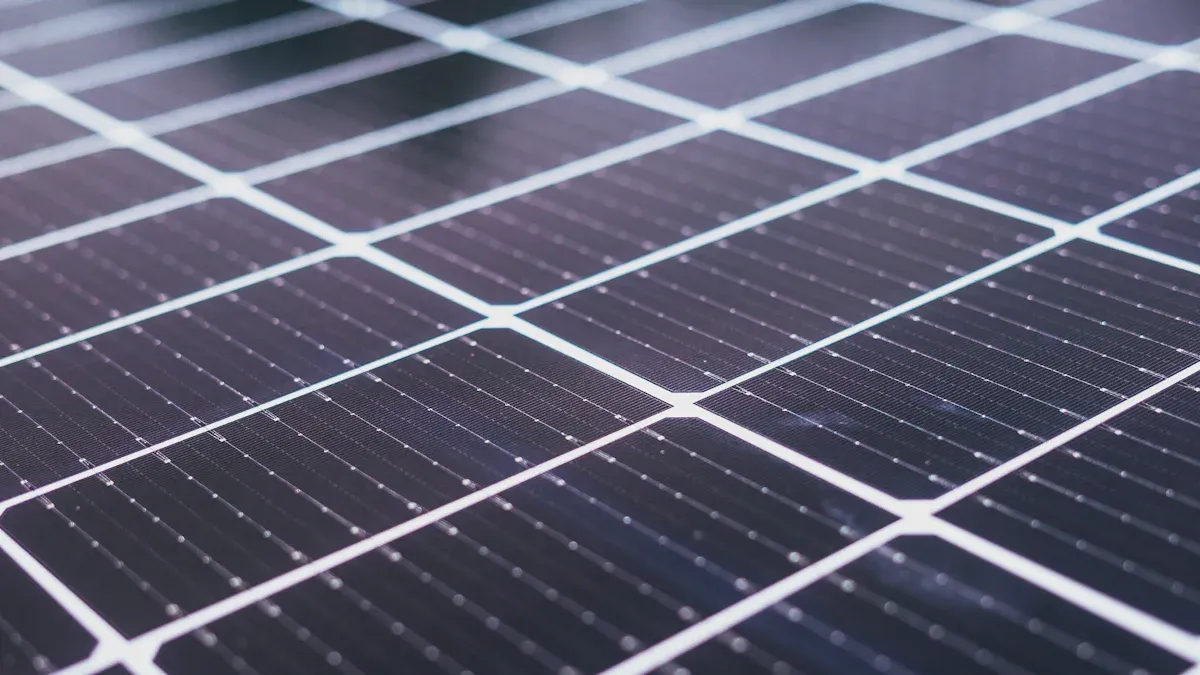
If you ask what are solar panels made of, the answer is a mix of materials. These materials work together for strength and to generate energy. At the core, you will find silicon cells. Strong glass covers these cells, while an aluminum frame holds everything securely in place. Plastic polymers seal the panel, and copper along with small amounts of other metals assist in moving electricity. Each component plays a vital role in ensuring the panel operates efficiently. They also provide protection from heat, water, and potential damage.
Material | |
|---|---|
Glass | 76 |
Polymers | 10 |
Aluminum | 8 |
Silicon | 5 |
Copper | 1 |
Silver & Others | <0.1 |
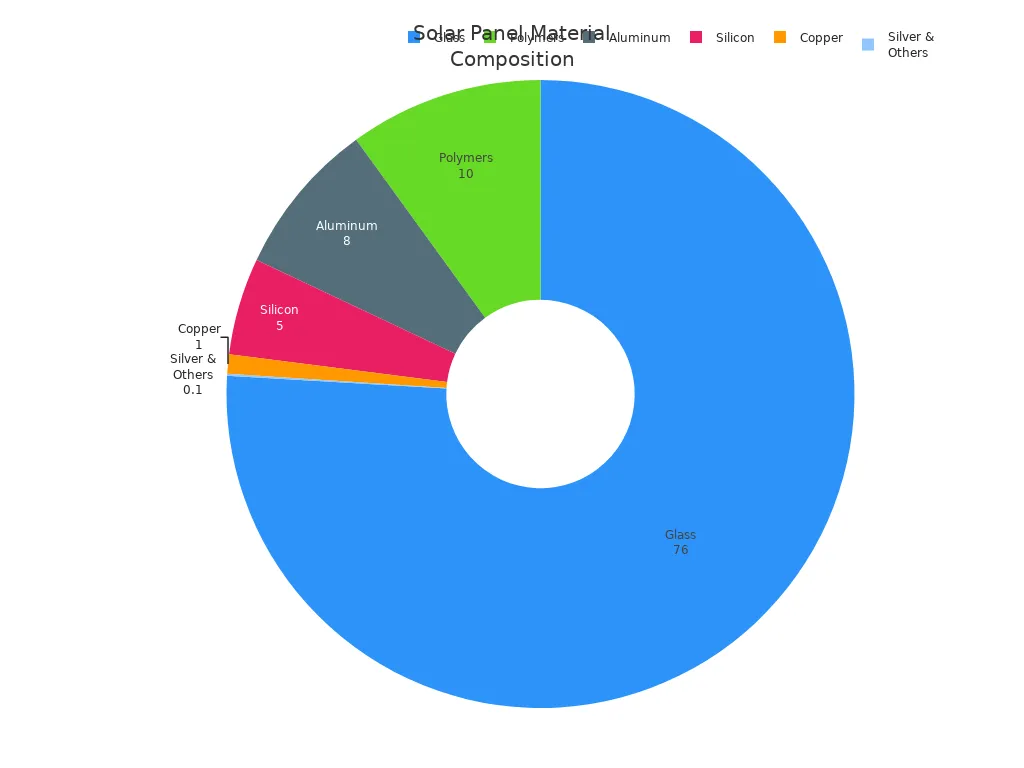
Solar panels use many materials. Silicon cells are in the middle. These cells change sunlight into electricity. Glass covers the silicon cells. It lets sunlight in but blocks bad UV rays. Aluminum frames make the panels strong. They also help with easy setup. Plastic polymers seal the panels. This keeps out water and dirt. It also helps the panels last longer. Copper and other metals move electricity from the cells to your house. There are different kinds of silicon. Monocrystalline and polycrystalline types change how well panels work and their price. Recycling solar panels matters a lot. Most parts can be used again. This cuts down on waste and helps the planet. Good materials in solar panels make them work better and last longer. This is good for people and the earth.
Silicon solar cells are the main part of a solar panel. Silicon is the most important mineral in solar panels. Almost every solar panel uses silicon to make electricity from sunlight. The special structure of silicon lets electrons move when light hits it. This movement creates electricity for homes and devices.
You may wonder how silicon cells change sunlight into energy. The answer is in how silicon atoms are arranged. The crystal pattern lets electrons move easily. This helps silicon take in sunlight and release electrons to make electricity. Here’s how it works:
The crystal pattern of silicon helps electricity move well.
Silicon’s four outer electrons make a strong pattern, which helps sunlight get absorbed.
Silicon is always the key mineral for making energy in solar panels. How well this works depends on the type and purity of silicon.
Solar panels use different kinds of silicon, and each has its own efficiency. Monocrystalline silicon is made from one crystal and is very pure. It works better and gives more power in hot weather. Polycrystalline silicon has many crystals, so it is less efficient but costs less. Some panels use special silicon types like bifacial mono-PERC or TOPCon n-type for even higher efficiency.
Type of Silicon | Efficiency Range |
|---|---|
Polysilicon | 16-17% |
Monocrystalline | 19-20% |
Bifacial Mono-PERC | Up to 22.5% |
TOPCon n-type | 25-26% |
Amorphous silicon | 11-12% |
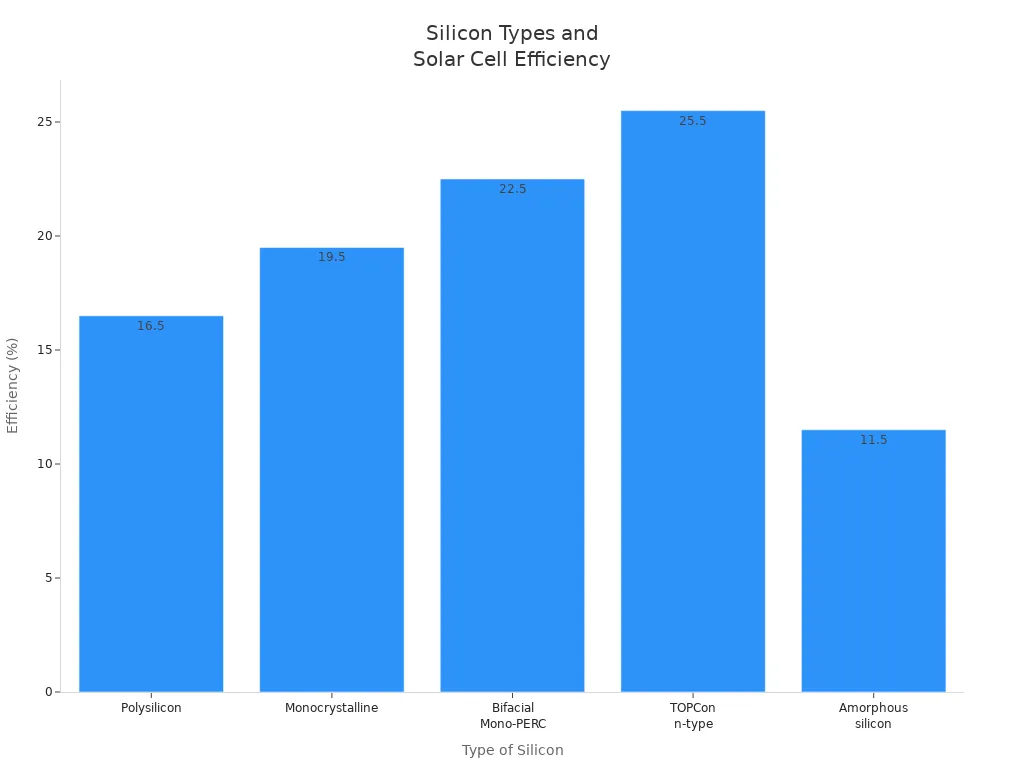
Most high-end panels use monocrystalline silicon cells. These panels make more power in small spaces. Polycrystalline silicon cells cost less, but they are not as efficient. Amorphous silicon is used in thin-film panels, which are good for flexible or portable uses.
The glass layer sits on top and protects the silicon cells. Glass is the heaviest part of a solar panel. Every solar panel uses glass to keep the inside safe from weather and damage. Silica is the mineral that makes up the glass in solar panels.
Glass gives solar panels many ways to stay safe. It lets lots of sunlight reach the silicon cells. The glass blocks UV rays, so the cells do not get damaged. Special coatings help the glass take in more sunlight. The glass is hard and does not scratch easily. It also resists chemicals and pollution. Strong glass helps panels survive hail and storms.
Letting in more light helps make more electricity.
UV resistance keeps the cells safe from the sun.
Special coatings help the glass take in more light.
Hard glass stays clear and strong.
Chemical resistance stops rust and damage.
Strong glass protects against hail and storms.
How thick the glass is also matters. Thicker glass (4 mm) protects better from hail and cracks, but it can reflect more light and lower efficiency. Thinner glass (2 mm) lets in more sunlight but can break more easily.
Thickness (mm) | Impact on Durability | Impact on Efficiency |
|---|---|---|
2 | Lower resistance to environmental stress | Higher light absorption |
4 | Better resistance to impacts and cracking | Slightly reduced light absorption |
Aluminum frames hold all the parts together and give the panel its shape. Aluminum is always used in solar panels. Every solar panel uses aluminum to keep the structure strong and protect the minerals inside.
Aluminum is strong but not heavy. This makes frames easy to carry and install, but still strong enough for wind and snow. Most solar panels use special aluminum alloys like 6063, 6061, and 6005. These alloys do not rust and last a long time outside.
Aluminum is very strong for its weight. This means frames are easy to move and install, but they can handle strong winds and heavy snow without bending.
The shape of the aluminum frame can be changed to fit different places. Aluminum does not rust, so panels stay strong in any weather.
Evidence | Explanation |
|---|---|
Lightweight yet strong characteristics of aluminum | This property facilitates easy handling and installation, contributing to installation flexibility. |
Corrosion resistance | Ensures durability in various environmental conditions, enhancing structural integrity. |
Extrusion process | Allows for customization of frame shapes, integrating functionalities and reducing the need for additional components, which supports installation flexibility. |
Aluminum is important for its strength and light weight. You need aluminum frames to keep all the parts safe and secure.
Plastic polymers are very important in solar panels. They are used as encapsulants and backsheets. These layers keep the silicon cells safe from water, dust, and damage. They also help the panel last for many years.
Encapsulation means sealing the solar cells inside. You need clear and strong materials for this. The most common plastic polymers in solar panels are:
Ethylene Vinyl Acetate (EVA): EVA is the main encapsulant. It sticks to glass and silicon. EVA is clear, so sunlight can reach the cells. It also blocks UV rays, which helps the panel last longer.
Polyvinyl Fluoride (PVF): PVF is used in the backsheet. It protects the panel from weather and damage.
Polyethylene Terephthalate (PET): PET is another backsheet material. It makes the panel stronger and keeps it safe.
Fluoropolymer Films (ETFE or PVDF): These films sometimes cover the front. They let in lots of sunlight and protect the inside.
Polyimide: Polyimide can handle high heat. It keeps the panel safe when it gets hot and helps with insulation.
These polymers keep your solar panels safe and working. They block water, dirt, and chemicals. They also stop UV rays from hurting the cells.
Tip: If you pick panels with good polymer layers, they will last longer and work better in bad weather.
Polymer backsheets like PVF and fluoropolymers are tough. They resist UV rays, humidity, and chemicals. This helps your solar panels last 20-25 years, with only a small drop in power each year—usually less than 1%. If you use recycled plastics, the panels can still last 15-20 years.
Metals in solar panels help move electricity from the silicon cells to your home. Copper is the main metal for this, but other metals are important too.
You need metals that carry electricity well to get the most power. Here are the main metals used:
Copper: Copper is the main wiring in solar panels. It moves electricity fast and well.
Silver: Silver is in the thin lines on solar cells. Silver carries electricity better than any other metal. It helps collect and move the electric current.
Aluminum: Aluminum supports the panel and sometimes helps with wiring. It is light and does not rust.
Zinc: Zinc coats some metal parts to stop rust.
Stainless Steel: This metal makes the panel stronger and protects it from weather.
Other metals like cadmium, gallium, indium, lead, molybdenum, nickel, selenium, tellurium, and tin are used in small amounts. Each one helps with carrying electricity, protection, or making the panel work better.
The metal you choose changes the cost and how well your solar panels work. Look at this comparison:
Material | Cost per Pound | Efficiency (%) |
|---|---|---|
Silver | $308.03 | 25.26 |
Copper | $4.30 | 25.54 |
Copper costs much less than silver—about 100 times less. Using copper keeps solar panels cheaper. Copper is also easier to recycle and is found more often in nature. Silver makes panels work better, but it is expensive, so only a little is used.
Note: The right mix of metals in your solar panel gives you good performance without costing too much. Copper and silver together help your panel make more power in the same space.
Silicon is the most important part of every solar panel. You need silicon to change sunlight into electricity. This happens in a few steps. First, silicon takes in light from the sun. This makes many pairs of electrons and holes inside the cell. Next, electrons move to the negative side. Holes go to the positive side. Then, electrons travel through wires outside the cell. This flow makes the electricity you use at home. After that, electrons come back to the cell. The process starts again and keeps making power. Silicon does much more than just sit in the panel. It is the main part that changes sunlight into energy. Without silicon, your solar panel would not make any electricity.
The glass layer sits on top and keeps the inside safe. Companies use tempered glass because it is very strong. This glass can take hits from hail or flying things. Its hard surface stops scratches and keeps the panel clear. Sunlight can always reach the silicon cells. The glass also blocks water and bad UV rays. This keeps your solar panel working for a long time. It works well in all kinds of weather. You get good power, even when the weather is rough or changes a lot.
Tip: If you keep the glass clean, more sunlight gets in. This helps your panel make more electricity.
Aluminum frames give your solar panel its shape and strength. They do more than just hold the parts together. Here is how aluminum helps your solar panel:
Role | Description |
|---|---|
Protection | Keeps inside parts safe from heat and bumps during shipping and storms. |
Mounting Points | Makes it easy to put panels on roofs or on the ground. |
Structural Stability | Gives strong support and protects from birds or storms. |
Withstanding Adverse Conditions | Keeps the panel stiff, so it can handle heavy snow and strong winds. |
Dust Resistance | Stops water and dirt, lets water drain, and keeps wires safe. |
Thermal Management | Helps cool the panel, so it works well all the time. |
Aluminum makes your solar panel strong and easy to set up. The frame keeps all the parts safe, no matter where you put your panels.
Polymers help solar panels last longer and work better. These special plastics are found in two main places. They are used as encapsulants and backsheets. Each polymer type helps the panel in its own way.
You need polymers to keep solar cells safe. These materials make a shield around the cells. The shield blocks water, dust, and UV rays. You cannot see these layers, but they protect the cells every day.
Polymers make strong barriers that stop water and dust.
They let sunlight go through, so panels make more electricity.
Each polymer has special features that help panels last longer.
Good encapsulation keeps panels working well. Without it, panels lose most of their power and drop to only 13% output.
Materials like EVA and silicone let sunlight in but keep out heat and moisture.
EVA is often used as the main encapsulant. This clear plastic wraps around silicon cells. It sticks to glass and silicon, so nothing moves. EVA also blocks UV rays and keeps cells from wearing out fast. Silicone is another polymer that helps with insulation. It can handle high heat, so panels stay safe on hot days.
The backsheet is another layer made from polymers like PVF or PET. This layer sits at the bottom of the panel. It keeps out water and dirt. It also stops electricity from leaking. Some panels use fluoropolymer films like ETFE or PVDF on the front. These films are tough and let in lots of sunlight.
Tip: If you want your solar panels to last many years, pick ones with good polymer layers. These layers help panels resist weather, heat, and chemicals.
Polymers do more than protect. They help panels stay flexible and light. This makes installation easier and stops panels from cracking. When you choose a solar panel, check what polymers are used. Good polymer layers mean better performance and longer life for your solar panels.

When you see a solar panel, it looks finished. But every panel starts with simple raw materials. These materials decide how well your solar panels work and how long they last.
Silicon metal is the most important part of solar panels. You need very pure silicon to make solar cells that turn sunlight into electricity. Most companies use metallurgical-grade silicon, called MGS. This kind of silicon is pure enough for solar panels.
About 12% of all silicon metal made becomes MGS for solar panels.
China makes most of the world’s MGS, about 70%. The country also makes 77% of the world’s polysilicon.
Xinjiang, a place in China, makes almost half of the world’s polysilicon.
Polysilicon is a very pure type of silicon. Factories make polysilicon by cleaning MGS with hydrogen and chlorine. These gases help remove things that should not be there. Then, factories melt the polysilicon at high heat. They pour it into molds to make big blocks called ingots. Workers cut these ingots into thin wafers. These wafers become the solar cells inside your panels.
Tip: Better silicon metal means your solar panels can make more energy.
Aluminum alloy makes the strong frame around each solar panel. You need this frame to keep the panel safe and strong. Making aluminum frames takes a few steps. Here is a simple list:
Step | Description |
|---|---|
1. Raw material preparation and profile extrusion | Workers heat aluminum rods and shape them. Air-cooling makes the metal harder. |
2. Heat treatment and aging strengthening | The shaped metal gets treated to make it even stronger. |
3. Surface treatment (anodization) | Sandblasting and anodizing stop rust and make it look nice. |
4. Precision machining | Machines cut and punch the metal to the right size and shape. |
5. Assembly and quality control | Workers put the frames together and check for quality. |
6. Packaging and anti-damage design | The frames get packed carefully to stop damage during shipping. |
Aluminum alloy frames help your solar panels last longer. They are light and strong, so they are easy to install.
Solar panels use more than just silicon and aluminum. Other metals are important too. Copper and steel are used a lot. Copper helps move electricity fast. Steel makes some parts stronger.
Right now, getting these metals can be hard. Prices for metals like aluminum and steel have gone up. Some factories cannot get enough metal because of supply chain problems. Sometimes, companies send parts through other countries to avoid tariffs. This can slow things down and cause checks by the government. For example, the U.S. Department of Commerce has checked companies that ship Chinese parts to other countries before bringing them to the U.S. These problems make it harder to get all the metals needed for solar panels.
Note: When you pick solar panels, remember that the quality and where metals come from can change how well they work and how much they cost.
There are three main solar panel types. These are monocrystalline, polycrystalline, and thin-film. Each type uses different materials. Each works best in certain places. Knowing these differences helps you choose the right panel.
Monocrystalline panels use one silicon crystal for each cell. They look dark black and have rounded corners. The single crystal helps electrons move easily. This makes these panels work very well.
Type of Solar Panel | Material Composition |
|---|---|
Monocrystalline | Made from a single silicon crystal. |
Monocrystalline panels are very efficient. They turn more sunlight into electricity than other types. You need less space for the same power. These panels last a long time and handle heat well. They cost more, but they work better.
Type of Solar Panel | Efficiency | Cost | Additional Notes |
|---|---|---|---|
Monocrystalline | High efficiency | Higher cost | Made from single-crystal silicon, durable. |
Tip: If your roof is small and you want lots of power, pick monocrystalline panels.
Polycrystalline panels use many silicon crystal pieces melted together. They look blue and have square corners. The mixed crystals make it harder for electrons to move. These panels do not work as well as monocrystalline ones.
Type of Solar Panel | Material Composition |
|---|---|
Polycrystalline | Made from multiple silicon crystal fragments. |
Polycrystalline panels are less efficient. You need more space for the same power. These panels cost less, so they are good for smaller budgets. They last many years and work well in most weather.
Type of Solar Panel | Efficiency | Cost | Additional Notes |
|---|---|---|---|
Polycrystalline | Lower efficiency | More affordable | Made from multiple silicon crystals, requires more space. |
Note: If you want to save money and have lots of space, polycrystalline panels are a good choice.
Thin-film panels use different materials. Some common ones are:
Cadmium Telluride (CdTe)
Amorphous Silicon (a-Si)
Copper Indium Gallium Selenide (CIGS)
Type of Solar Panel | Material Composition |
|---|---|
Thin-film | Can be made from CdTe, amorphous silicon (a-Si), and CIGS (copper indium gallium selenide). |
Thin-film panels look different from silicon panels. They are thin, light, and sometimes bendable. You can use them on curved or odd surfaces. These panels cost less to make. They do not turn as much sunlight into electricity. You need more space for the same power. Thin-film panels work well in low light and high heat.
Type of Solar Panel | Efficiency | Cost | Additional Notes |
|---|---|---|---|
Thin-film | Lower efficiency | Lower manufacturing cost | Lightweight and flexible, suitable for irregular surfaces. |
If you need panels for a big area or want something flexible, thin-film panels are a good choice.
Each panel type uses different materials and has its own benefits. Your choice depends on your budget, space, and how much energy you need.
You might wonder what happens to old solar panels. Most parts of a solar panel can be recycled. You can get back glass, aluminum, silicon, copper, and even some silver. These materials make up almost the whole panel. Recycling saves resources and cuts down on waste.
Here is a table that shows how much of each material you can get from a solar panel:
Material | Percentage of Panel | Recovery Rate |
|---|---|---|
Glass | 70-75% | ~90% |
Aluminum Frame | 10-13% | >95% |
Silicon Cells | 3-4% | ~85% |
Copper Wiring | 1-2% | >95% |
Silver | Small quantity | Up to 80% |
Polymer Components | 10-13% | ~50% |
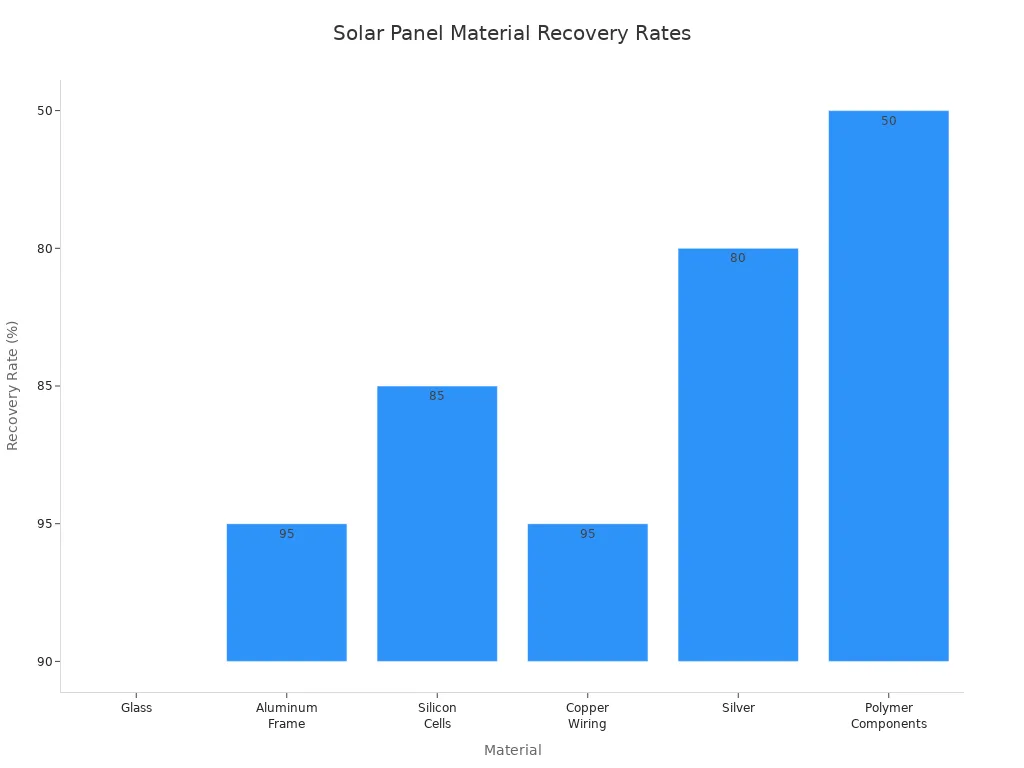
Glass and aluminum are the easiest to recycle. Silicon and copper are also easy to recover. Polymers are harder to recycle, but you can still get about half of them back.
Recycling a solar panel has a few main steps. Each step helps you get back useful materials.
Take off the aluminum frame and the junction box.
Separate the glass from the silicon wafer. You can use heat, machines, or chemicals for this.
Clean and separate the silicon cells and metals like silver, tin, lead, and copper. Chemical and electrical methods help with this.
You can get back most of the glass and aluminum—up to 95%. Silicon cells can be recovered at rates of 80-85%. Metals like copper and silver can be recovered at over 90%. This process lets you reuse materials and keeps them out of landfills.
Recycling solar panels saves energy and resources. It also means you do not need as many new materials.
Recycling solar panels helps the environment a lot. When you recycle, you can get back over 90% of the materials in a panel. This means you do not need to mine as much. You help the earth by using what you already have.
If you throw solar panels in the trash, bad materials can leak into the ground and water. Burning panels can put harmful gases in the air. Recycling stops these problems and keeps the environment safer.
Recycling means less mining for new materials.
Throwing panels away can pollute soil and water.
Burning panels can cause air pollution.
Recycling helps the economy by getting valuable materials back.
When you recycle solar panels, you help the planet and make the future cleaner. Recycling is the best way to deal with old solar panels and protect the environment.
Many new materials are changing how solar panels work. These changes help panels last longer and work better. They also help protect the environment. The solar industry wants panels to be more efficient and easier to recycle. This means you get more energy from the same sunlight. It also means less waste goes to landfills.
A big change comes from perovskite solar cells. These cells have a special crystal structure. They absorb sunlight very well. You can make perovskite cells at lower temperatures. This makes them cheaper and easier to make. Perovskite panels work well in low light. You get power even on cloudy days.
Another important material is in thin-film solar cells. These panels use cadmium telluride (CdTe) and copper indium gallium selenide (CIGS). Thin-film panels are much lighter than silicon panels. You can bend them or use them on surfaces that are not flat. They cost less to make and install. This helps more people use solar power.
New recycling technology lets you recover more materials from old panels. You can reuse glass, silicon, and metals instead of throwing them away. Closed-loop systems help factories use fewer new resources. They also create less pollution. These changes make solar panels better for the planet.
Companies now use better coatings and encapsulants. These new layers protect cells from water, heat, and UV rays. Your solar panels last longer and keep working well for many years.
Here are ways new materials help solar panels: Increase efficiency, so you get more power from each panel. Lower costs, making solar energy more affordable. Reduce waste, helping the environment. Make panels lighter and easier to install.
Haina helps make solar panels stronger and more reliable. You benefit from their focus on better materials and smart designs. Haina makes high-quality C channel steel solutions for solar mounting systems. This steel gives your solar panels a strong base. They stay safe in wind, rain, or snow.
Haina’s C channel steel has a special shape that resists bending. Your panels will not sag or break, even after many years.
The steel has coatings that stop rust and corrosion. Your solar system stays strong and looks good for a long time.
Haina tests each product for load-bearing capacity. You can trust your panels will stay in place, no matter the weather.
If you choose solar panels with Haina’s mounting systems, you get better durability and longer life for your investment.
Haina’s work helps the whole solar industry move forward. Their focus on material quality and smart engineering means you get safer, more efficient solar panels. As new materials and designs keep improving, you will see even better performance and sustainability from your solar energy system.
Solar panels have silicon, glass, aluminum, polymers, copper, and other metals. Every material helps the panel work better and last longer. New things like glass-glass modules and lead-free designs make panels safer. These changes also make recycling easier. Pick solar panels with strong materials and smart new ideas. This helps your panels last more than 30 years. It also keeps the environment safe. ��
Silicon is the main material. It helps change sunlight into electricity. Silicon sits in the middle of every solar panel. It makes power for your house.
Yes, you can recycle most parts of a panel. You get back glass, aluminum, silicon, and copper. Recycling saves resources and stops waste from going to landfills.
Solar panels use safe materials. Most panels do not have toxic chemicals. Recycling old panels helps keep the environment clean.
Solar panels last about 25 to 30 years. Strong glass and aluminum frames help them work for a long time.
Most panels use silicon, glass, aluminum, and polymers. Thin-film panels use other materials like cadmium telluride or CIGS. Check the type before you buy.
If a panel breaks, you can fix the glass or frame. You should recycle broken parts. This keeps bad materials out of nature.


