

Views: 0 Author: Site Editor Publish Time: 2025-09-19 Origin: Site


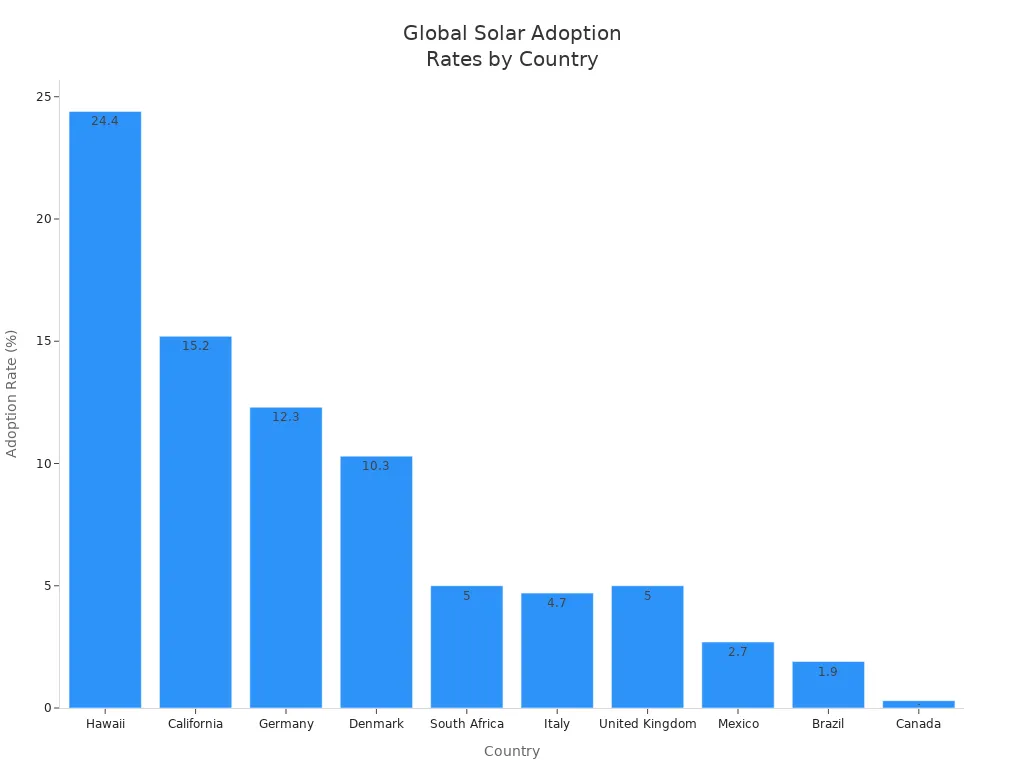
If you wonder whether solar energy is right for your home, you probably want a quick rundown of the main solar energy pros and cons. Solar energy gives you a clean, renewable energy source that can lower your bills, shrink your carbon footprint, and offer more independence from the grid. Many homeowners in places like Hawaii and California already use solar panels, as you can see in the chart below.
Still, you face some downsides. Upfront costs can be high. Solar panels work best in sunny spots and don’t always give full power on cloudy days. You also need enough space for the panels. Weigh these factors as you think about joining the move to renewable energy.
Solar energy is a renewable resource. It will never run out. This makes it a smart choice for homeowners. Using solar panels can lower your electricity bills a lot. Many people save about $1,500 each year. Solar energy has a low impact on the environment. It does not make harmful emissions. It helps to reduce pollution. The first cost of solar panels can be high. Government incentives can help lower these costs. Solar panels work best in sunny places. Their efficiency can change with the weather. Not every home can use solar panels. You need enough roof space. The roof must have the right angle for sunlight. Investing in solar can raise your home's value. Homes with solar systems often sell for more. Regular maintenance is important. Cleaning the panels helps your solar system work well.
When you check the solar energy pros and cons, you find good things and some problems. This guide helps you see if solar is right for you.
Solar energy comes from the sun. The sun gives us power that never runs out. You do not need to worry about running out of fuel or prices going up. This makes solar power a smart choice for your home.
You help the earth when you use solar energy. Solar panels do not make bad emissions or pollution. They need little care because they have no moving parts. You just clean them sometimes to keep them working well.
Many people choose solar to save money. You can pay less for electricity each month. This helps when prices go up. Over time, you can save thousands of dollars. Some people also see their home value go up by 4% or more.
With solar panels, you use less power from the grid. If you add batteries, you can keep your lights on during outages. This gives you more control over your energy and protects you from price jumps.
Solar panels work in many places and on different homes. Even when it is cloudy or cold, your system can still make power. Snow can help by bouncing sunlight onto your panels.
Tip: The federal solar tax credit can help you pay less at first, so solar is easier to afford.
Solar panels cost a lot at first. Most people pay between $11,000 and $18,500 before help from incentives. The solar tax credit helps, but you still need to plan for this cost.
Solar panels do not turn all sunlight into electricity. Most systems work at about 21% efficiency. You need enough panels and space to get the power you need.
Solar energy needs sunlight. Cloudy days, shade, or the way your roof faces can lower your power. You may need backup power or batteries for cloudy times.
Not every roof works for solar panels. You need enough space and the right angle to catch sunlight. Some homes or apartments may not be good for solar.
Here is a table to help you compare the main pros and cons of solar energy:
Pros | Cons |
|---|---|
Renewable energy source | High upfront cost |
Low maintenance | Efficiency limits |
Lower electric bills and savings | Weather dependence |
Increases home value | Space and roof limitations |
Works in many climates | Storage can be expensive |
When you look at the good and bad sides of solar energy, you see that solar can help a lot, but you must think about the problems too. Think about your home, your money, and your plans before you choose solar.
When you get a solar panel system, you start saving money. The sun gives your home energy, so you buy less from the grid. Most people in the United States save about $1,500 each year. Some save even more, up to $1,820 every year. This depends on how much sunlight your roof gets and how much energy you use. These savings add up over time. They can really help your budget.
You pay less for electricity each month.
Your savings grow if energy prices go up.
You keep more money for other things.
Government incentives make going solar easier. These programs help lower the cost of your solar panel system. You can get a federal solar tax credit for 30% of your project’s cost. If your solar project costs $28,000, you might pay only $16,900 after incentives. Some states and cities give extra rebates, like $300 for every kilowatt you install. A 9 kW system could get you another $2,700 off.
Incentives make solar energy cost less.
You get your money back faster.
Your home’s value can go up if you want to sell.
Tip: Check local programs and rebates before you go solar. You might find more ways to save.
Solar energy helps fight climate change. When you use solar power, you make less carbon emissions. In the U.S., solar energy cuts about 8.5 million tons of CO2 each year. This helps the country reach cleaner air goals. By choosing solar, you help protect the planet for the future.
You lower your carbon footprint.
You help keep the air clean.
You join others making a good impact.
Solar panels make electricity without harmful pollution. Unlike fossil fuels, solar energy does not make carbon dioxide or sulfur dioxide. You get clean power and no dirty air. The Department of Energy says solar energy helps cut greenhouse gases and pollution. Solar panels use very little water. They can go on your roof, so they do not need extra land.
Aspect | Solar Energy | Fossil Fuels |
|---|---|---|
Greenhouse Gas Emissions | Minimal | Major contributor |
Air Pollution | None | Significant |
Water Usage | Little to none | High |
Land Use | Can use rooftops | Requires large areas |
Solar energy pros and cons often talk about the environment. Solar panels give you clean, renewable energy with almost no pollution.
Solar energy is a long-term answer for your home. The sun will shine for billions of years, so you never run out of power. Solar panels last for decades. Recycling programs help keep old panels out of landfills. By going solar, you help with sustainable growth. You meet today’s needs without hurting the future.
Solar energy is always there and reliable.
Recycling panels makes solar even better.
You help build a cleaner future.
Solar panels have a small effect on the environment. They do not make greenhouse gases or air pollution when making electricity. Solar energy systems use very little water. They can fit on rooftops, so they do not hurt natural habitats. Compared to other energy sources, solar power is better for the environment.
You pick an energy source with little impact.
You help save land and water.
You support a cleaner, greener world.
Thinking about the advantages and disadvantages of solar energy? Solar panels give big benefits for your wallet and the planet, with only a few problems to think about.
When you want solar, the first thing you see is the cost. Getting a solar panel system is a big spend for your home. Most people pay between $18,000 and $38,000 after the 30% federal solar tax credit. This price covers panels, inverters, wires, and labor. The cost changes with your roof size, where you live, and how much energy you want.
You pay more at first, but you can save later.
The solar tax credit cuts your cost right away.
Some people wait for lower prices or better deals.
You should plan for this big cost. It can seem like a lot, but many families think the savings are worth it.
You do not have to pay for solar all at once. There are different ways to make solar easier to buy. Here is a quick look at the most common ways to pay:
Financing Option | Description | Benefits | Drawbacks |
|---|---|---|---|
Cash Purchase | You buy the solar system with your own money. | You save the most, get energy freedom, and can use incentives. | You need a lot of money at the start. |
Solar Loans | You borrow money to buy the system. | You own the system, get incentives, and can use net metering. | You need good credit, and interest rates can change. |
Solar Lease | A company owns the system, and you pay for the power. | No big payment at the start, and they fix things if needed. | You pay each month, and you do not own the system. |
Power Purchase Agreement | You agree to buy power from a company’s solar system. | You pay for what you use, and there is no big payment at the start. | You may need to buy more power from the grid if you use extra. |
Pick the way that works best for your money and needs. Some people want to own their system for bigger savings. Others like a lease or agreement to skip the big payment. No matter what you choose, you can still get solar energy’s benefits.
Solar panels turn sunlight into electricity, but not all of it. Most solar panels work at about 22% to 24% efficiency. This means they use only part of the sunlight they get. The best silicon panels could reach about 29.4% in theory. Newer types, like tandem and perovskite cells, may get close to 30% soon.
Spectral mismatch causes about 25% of energy loss.
Recombination losses take away 15-20% of power.
Resistive losses add 5-8% more loss.
High heat can lower output by 0.3% for each degree Celsius.
Some companies, like Oxford PV, made panels with 26.8% efficiency. As technology gets better, you may see higher numbers. For now, no solar panel can use all the sunlight it gets.
Weather affects how well your solar panels work. Sunlight is needed for making electricity, but other weather matters too. When the sun is bright, your panels make more power. On cloudy days, you get less energy. High heat can hurt how well panels work, but cool weather helps.
Sunlight is key, but too much heat lowers output.
Solar panels often work best in cool or mild weather.
Long hot spells can drop voltage and total energy.
You may need to change your system or add batteries for these problems. Good planning helps you get the most from your solar panels, no matter the weather.
Keeping your solar panels clean helps them work well. Dirt, dust, and leaves can block sunlight and lower energy. You should check and clean your panels two to four times a year. Use a soft brush and soapy water. If your panels are on the roof, you might want a pro for safety.
Clean panels early in the morning to avoid heat.
Regular cleaning keeps your system working well.
If you live where it is dusty, clean more often.
Watch your system’s output to know when to clean. If you see less energy, it may be time to wash your panels.
Solar panel systems do not need much fixing, but problems can happen. Most issues come from equipment like inverters, which break more than panels. If something breaks, repairs can start at $125 per hour. Harder fixes may cost $150 or more per hour. If you need to move panels for roof work, it could cost $3,000 to $10,000.
Most repairs are rare and happen in the first few years.
Inverters break more often than panels.
Regular checks help you find problems early.
You can keep your solar panels working well with simple care and quick fixes. This helps you enjoy solar energy for many years.
When you look at solar energy for your home, you want to know what you get and what you might lose. Here is a simple table that shows the main good and bad sides. The table and lists below help you see if solar is right for you.
Pros of Solar Energy | Cons of Solar Energy |
|---|---|
Renewable and sustainable | High upfront cost |
Reduces electricity bills | Weather dependence (needs sunlight) |
Low environmental impact during use | Space requirement (needs roof or land) |
Increases home value | Expensive storage (batteries) |
Promotes energy independence | Efficiency limits (not all sunlight converted) |
Federal, state, and local tax credits | Environmental impact from manufacturing/disposal |
Cost-effective over time | Limited recycling options for old panels |
Can eliminate your electric bill | Material scarcity for some panel types |
Creates jobs in your community | Requires proper disposal at end of life |
�� You use a renewable resource. The sun gives energy every day, so it never runs out.
�� You save money on your electric bills. Some people do not have bills after getting solar.
�� Your home value can go up. Buyers like homes with solar panels.
�� You help the environment. Solar panels make clean energy and lower pollution.
�� You get tax credits and rebates. The government helps you pay less for your system.
�� You gain energy independence. You do not need the power grid as much.
�� You support new jobs. Solar creates work for people in your area.
Tip: Many people save a lot of money over time, especially when energy prices go up.
�� You pay a lot at first. Solar panels and installation cost thousands of dollars.
☁️ You need sunlight. Cloudy days and shade mean you get less energy.
�� You need enough space. Not every roof or yard works for solar panels.
�� Batteries cost extra. If you want power at night or during outages, storage adds to the price.
♻️ Making and throwing away panels can hurt the environment. Factories use energy and some materials are hard to recycle.
⚡ Panels don’t use all sunlight. Most panels only turn about 20% of sunlight into power.
��️ Proper disposal is important. Old panels need safe recycling to avoid pollution.
Solar energy has many good points, but there are some problems too. Think about these things before you decide.
Choosing solar energy is a big decision. You want to know if it fits your life, your home, and your goals. Let’s break down what you should think about before making the switch.
Your budget plays a huge role in your solar journey. You need to look at more than just the sticker price. Think about the total amount you’ll pay over time, including any loan interest and fees. Here’s a quick checklist to help you:
Check the total payback value for your loan.
Compare interest rates from different lenders.
Look at the loan term—shorter terms mean higher payments but less interest.
Watch out for extra loan fees.
Decide if you want a secured or unsecured loan.
Research the lender’s reputation.
Tip: A good lender can make your solar investment smoother and less stressful.
Not every home is ready for solar panels. Your roof matters a lot. Asphalt shingles or metal roofs work best. South-facing roofs catch the most sun. You also need enough space for the panels. Make sure your roof is strong enough to hold the weight. If your roof is old or in bad shape, you may need repairs first.
Roof type and condition matter.
South-facing roofs get more sunlight.
You need enough space for all the panels.
The roof must be strong and in good shape.
Where you live changes how much energy your panels make. Homes near the equator get more sun and make more power. If you live farther north or south, you might see less energy, especially in winter. For best results, your home should get four to six hours of strong sunlight each day.
Aim for 4–6 peak sun hours daily.
Four to five hours is enough for most systems.
Many cities and states offer extra help for solar. These programs can save you thousands. Here are some examples:
State | Local Incentives |
|---|---|
Maryland | Property tax credits up to $5,000 per year in some counties |
Massachusetts | Municipal rebates plus state and federal incentives |
Minnesota | Upfront rebates of $500 from public utilities |
Florida | Energy Edge Rebate up to $1,500; Solar Energy Grant up to $2,500 |
Illinois | Illinois Shines Program offers renewable energy credits |
New York | 25% state tax credit up to $5,000; NY-Sun program up to 20 cents per Watt |
New Jersey | 100% sales and property tax exemption for solar PV systems |
Note: Always check for local programs before you buy. You might find new ways to save.
You want to know when your solar panels will pay for themselves. Most homeowners see a payback period between five and ten years. This depends on your location, how much energy you use, and your local utility rates.
Most payback periods are 5–10 years.
Some people see returns even sooner.
Solar panels can boost your home’s value. Homes with solar often sell for 4% more than those without. A typical 6-kilowatt system can add $24,000 to $36,000 to your home’s price. Buyers like solar homes, and they often sell faster.
Solar homes sell for 4.1% more on average.
Young buyers look for solar features.
Solar can help your home stand out in the market.
Thinking about your budget, your home, and your goals will help you decide if solar is the right move for you.
Solar energy can help you save money and keep the earth clean. But you must pay a lot at first and need a good roof. Think about your money, how much sun your home gets, and your future plans. Here are some easy steps to begin:
Make sure your roof and spot are good for solar.
Find out how much energy you use and what you can spend.
Look up programs and ways to pay for solar.
Ask different solar companies for prices.
Factor Type | What to Consider |
|---|---|
Economic | First cost and how much you save later |
Technological | If your roof fits and if it is easy to install |
Policy | Programs and ways to help pay |
Want to try solar? Start by checking your home and looking at your choices.
Most solar panels work for 25 to 30 years. You may see a small drop in power over time. You can keep them working longer with regular cleaning and quick repairs.
Yes, your panels still make power when it’s cloudy. You get less energy than on sunny days. You can add batteries to store extra power for later.
No, solar panels do not hurt your roof if installed right. Installers use special mounts to protect your roof. You should check your roof’s condition before you start.
Solar panels stop making power at night. You can use batteries to store energy for nighttime or outages. Without batteries, you use electricity from the grid.
You only need to clean your panels a few times each year. Remove dust and leaves to keep them working well. Most systems need little fixing.
You can try, but it’s safer to hire a pro. Installers know how to set up panels and connect them to your home. You avoid mistakes and get better results.
Yes! Homes with solar panels often sell for more money. Buyers like lower bills and clean energy. Your home may stand out in the market.
You may pay for permits, inspections, or repairs. Some systems need new inverters after 10 years. Ask your installer about all possible costs before you buy.


